When a storm knocks out water and sewer service, Nashville Porta Pros can have standard units on site within hours, not days. We keep stock staged for fast turnaround across Nashville and out to Hendersonville, 18.4 miles northeast, and Brentwood, 15.3 miles south. A single unit runs $150 to $300 a day in an emergency deployment.
Speed is the whole point of this service. A downed water main or a flooded lift station does not wait for business hours, and neither do we. Most emergency requests get a truck moving the same day, sometimes within a couple hours if the roads are clear and the site is reachable. Response time depends on where you are: a delivery inside Nashville proper moves faster than one out toward Gallatin, 27.4 miles northeast, or Mount Juliet, 20.7 miles east, simply because of drive time. If you are coordinating relief for a shelter, a church serving as a staging point, or a neighborhood cut off by flooding, emergency porta potty rental is the fastest path to working restrooms. We also stock handwashing station rental units and portable sink rental setups, because disaster response almost always means potable water access is compromised too, and OSHA 1926.51(a)(1) calls for an adequate supply of potable water at any place of employment, including a temporary relief site staffed by responders or contractors. For sites with no power, pair sanitation with a light tower rental so crews working overnight shifts aren't fumbling in the dark, since OSHA 1926.56(a) sets minimum illumination levels for active work areas.
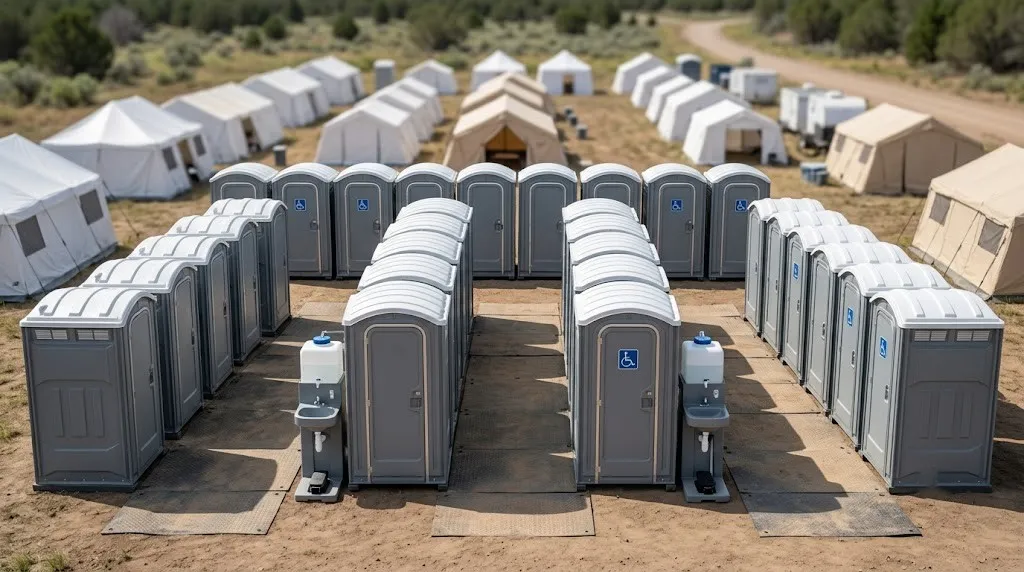
It depends on headcount and how long the site runs. A shelter housing displaced residents for a week needs a different mix than a two-day debris collection point. Start with standard porta potty rental units at a ratio that follows OSHA 1926.51(c)(1): one toilet for 20 workers or fewer, then one toilet and one urinal per 40 workers as headcount climbs past that, up to one per 50 at 200 or more. That ratio was built for construction crews, but it is the closest hard number available and it scales fine for a relief operation with a lot of hands on site. Every cluster needs at least one accessible unit; ADA Standards section 213.2 requires 5 percent of clustered portable toilets to be accessible, never fewer than one, so add an ADA accessible porta potty even for a small deployment. If the site includes any generator work, coating repair or pest treatment as part of cleanup, OSHA 1926.51(f)(1) requires washing facilities specifically for that paint, coating, herbicide or insecticide exposure. Longer-stay shelters do better with a restroom trailer rental, and a 2 stall restroom trailer or 4 stall restroom trailer handles a family shelter without a line forming. Debris removal almost always needs a roll-off dumpster rental alongside it, and a 20 yard dumpster rental clears storm debris fast without constant swaps.
Yes, and this is often the piece people forget until the toilets are already delivered. If a septic system backed up or flooded during the disaster, we run septic pumping service and can pump out a compromised tank before it becomes a second emergency. A typical residential tank is pumped every 3 to 5 years under normal conditions, but a flood event can force an out-of-cycle pump-out regardless of that schedule. For sites with no working plumbing at all, a holding tank rental gives you a place to store greywater or wastewater safely until service is restored. Handwashing matters just as much as toilets: 29 CFR 1910.141(d)(2) requires soap and towels or a hand-drying device at washing stations, and hand sanitizer alone does not satisfy that. If the relief site needs secure storage for donated supplies or equipment, a storage container rental or mobile office trailer rental keeps gear dry and locked. Sites that need to control foot traffic or keep people away from hazards should look at temporary fence rental or crowd control barrier rental, both of which we can deploy alongside the sanitation order in Nashville on the same run.
| unit | duration | typical price |
|---|---|---|
| standard | day | $150 |
| standard | week | $200 |
| ada | day | $230 |
| septic | day | $250 |
| delivery_fee | day | $150 |
Use OSHA 1926.51(c)(1) as your baseline: one toilet per 50 people at 200 or more, so 300 people needs roughly six units minimum, plus at least one ADA-accessible unit per ADA Standards 213.2. Our how many porta potties do I need guide walks through the math for mixed-use sites.
Same-day and after-hours delivery can carry a higher fee than a scheduled drop-off, and pricing depends on distance and how fast you need trucks moving. Ask about current emergency rates when you call; our porta potty rental cost page breaks down standard delivery pricing for comparison.
Usually, yes, but our driver needs to know about road conditions before the truck rolls. A roll-off delivery needs about 60 feet of straight clearance behind the truck, and a flooded or blocked route can force a different placement. Call ahead with site details.
We can add a light tower rental for overnight illumination and a temporary power pole for equipment needing 120 or 240 volt service. Pairing these with sanitation units covers most of what a powerless relief site needs in one order.
No. 29 CFR 1910.141(d)(2) requires soap plus towels or a hand-drying device at washing stations, and sanitizer alone does not meet that standard. Order a hand sanitizer station rental as a supplement, not a replacement for real handwashing.
Yes. Nashville Porta Pros delivers disaster relief sanitation across Nashville and the surrounding metro, with same-day and next-day drop-off available on most orders.
Pricing depends on the unit and how long you need it. See our cost breakdown and request a free quote for an exact figure.
Standard rentals include scheduled service — a pump-out, a clean, a restock and fresh deodorizer. Busy or hot-weather sites can be serviced more often.
Call now or request a free quote — clean units, on-time delivery, transparent pricing.